Services
Scissor sharpening and servicing
Specialised sharpening of hairdressing and grooming scissors, including straight, curved, thinning and chunker scissors. I adapt the process to the blade construction, the type of cutting edge and the condition of each pair.
When servicing scissors I always take them apart, clean them and work the blades. I pay particular attention to keeping the correct cutting-edge geometry and to precisely refinishing and polishing the ride line. Afterwards I reassemble the scissors, set the right blade tension and test the cut in practice.
Sharpening price
The price is normally set by the type of tool and how demanding the work is. From a description and photos I can give you an approximate estimate. If the inspection reveals unforeseen damage or the need for additional work, I let you know about any change in price before starting the extra work.
- Disassembly, cleaning and reassembly, with the blade tension set.
- Sharpening adapted to the construction and condition of the blades.
- Precise refinishing and polishing of the ride line.
- A practical cutting test along the full length of the blades, including the tip, with further adjustments as needed.
How the sharpening is done, step by step
Scissors that pull hair or fur, fold it instead of cutting it, or need more force to cut are not necessarily just blunt. The problem can also be damaged blade geometry, incorrect tension or worn ride surfaces.
So I do not treat scissors by sharpening the cutting edge alone. First I take them apart and inspect them, then decide how much work they need based on their construction and condition. The aim is for the two blades to work together properly, so the scissors cut smoothly and precisely again.
Inspection before sharpening
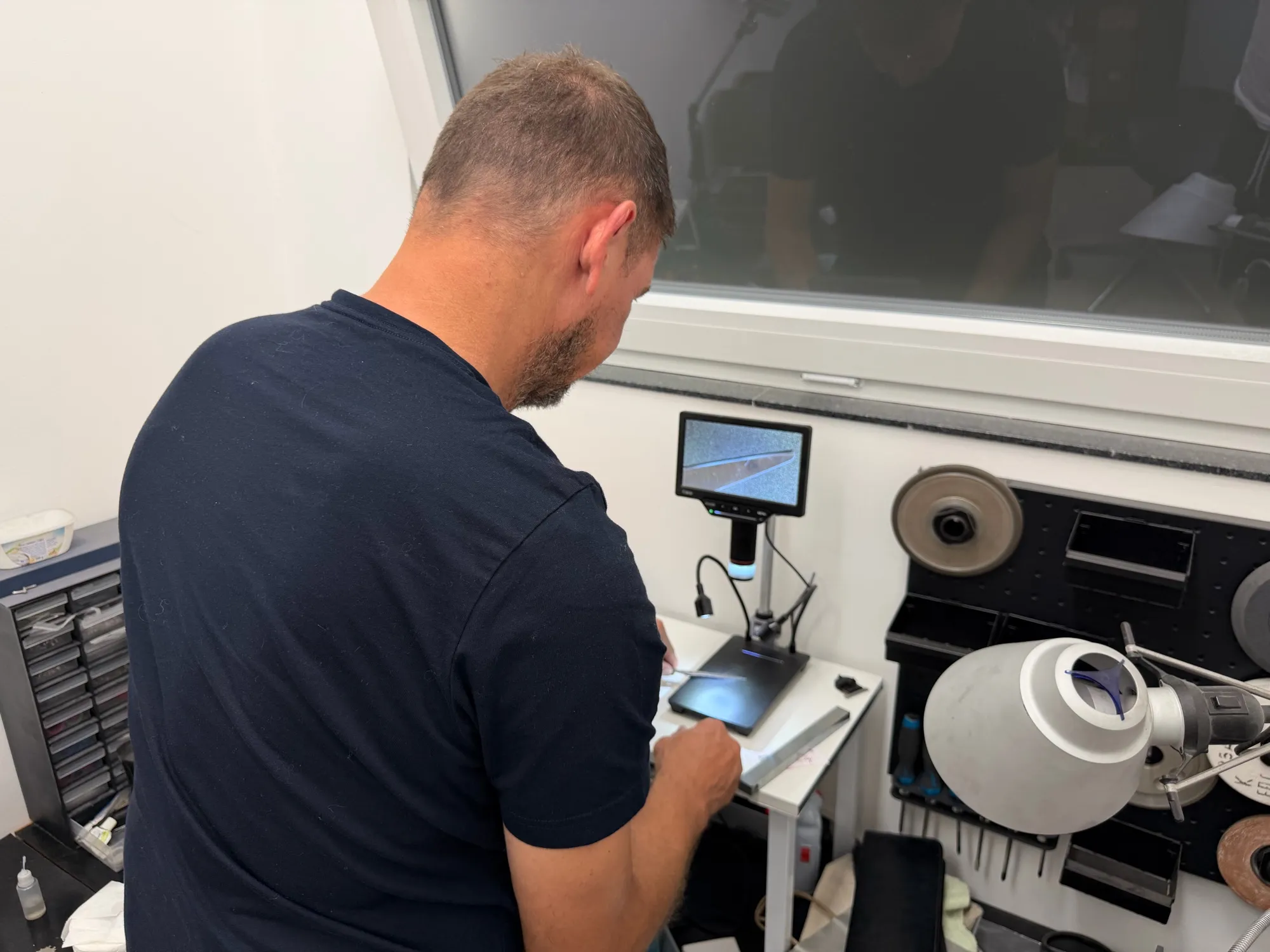
First I take the scissors apart and clean them. Then I inspect both cutting edges along their full length, any chips and deformation, the condition of the screw, and the ride surfaces along which the blades slide over each other.
The inspection shows what work is needed and how much material has to be removed. I take into account the construction of the scissors, the type of cutting edge and the effects of any earlier work.
Convex and bevel cutting edges
Hairdressing and grooming scissors differ in their cutting-edge geometry. On scissors with a convex edge the cutting face is characteristically curved, while scissors with a classic bevel edge have a more pronounced flat ground face.
The two designs call for a different approach to sharpening. I adapt the process to the construction of each pair, because incorrect work can change the blade geometry and worsen the cut. With a convex edge it is important to keep its curvature; with a bevel edge, the correct shape and angle of the cutting geometry.
By arrangement I can also put a micro serration on the cutting edge, where that suits the construction of the scissors and their intended use.
Chips and restoring the ride line
With deeper chips in the cutting edge it is often not enough to work only the damaged spot. To restore an even cutting edge the whole cutting face has to be ground until the damage is gone. That takes more material off and can affect the geometry and the working life of the scissors.
With more extensive grinding the work can also reach the ride line, which is essential for the two blades to slide and work together properly. If its geometry is disturbed, it has to be precisely reshaped and polished again so the scissors can work properly.
Straightening bent scissors
If scissors have been bent by a fall, the blades may also need straightening before they can work properly again. How much work that takes depends on the condition of the scissors and how far they can be restored.
Assembly, adjustment and cutting test
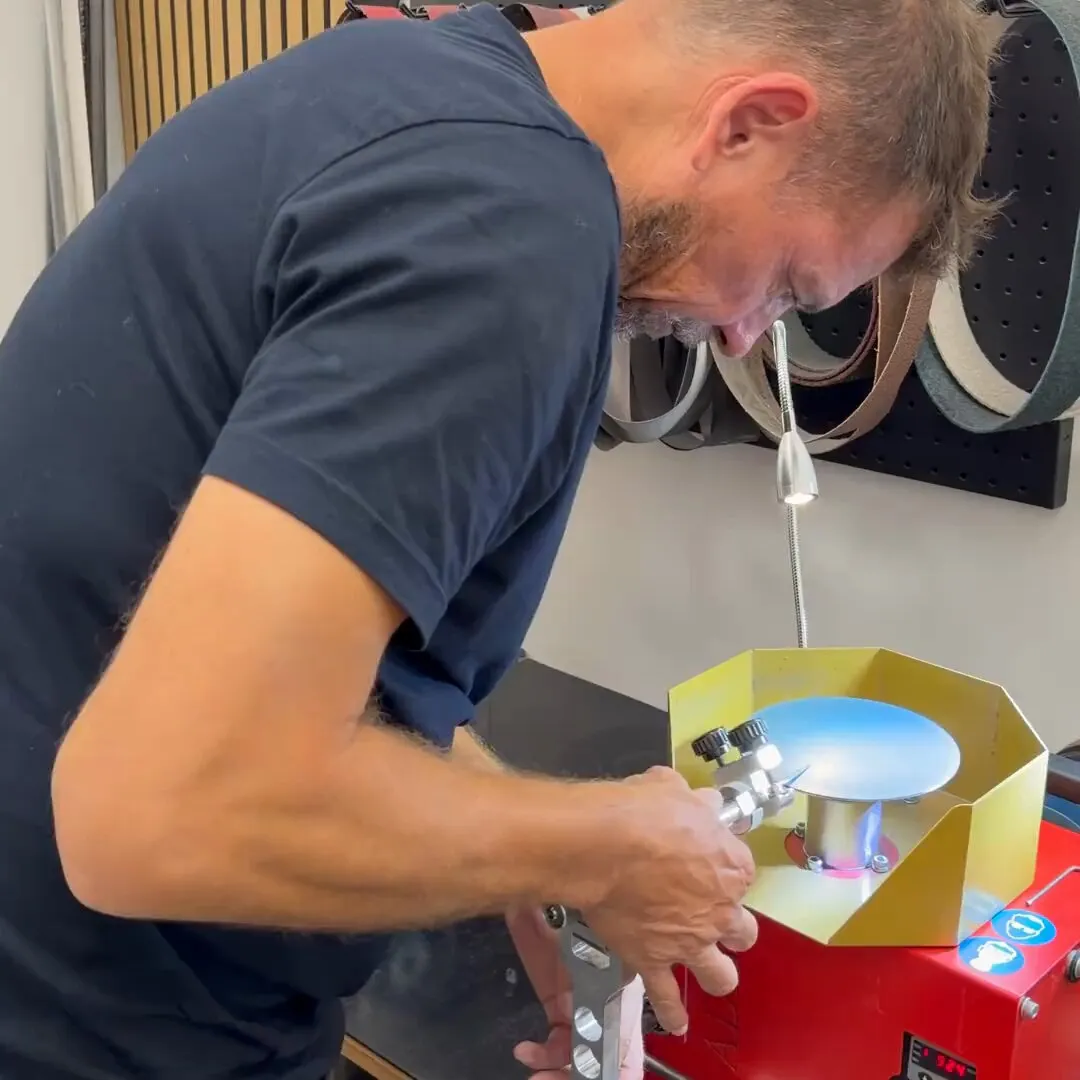
When the work is done I reassemble the scissors, oil them and set the blade tension. It has to let the blades slide smoothly while their cutting edges still meet correctly.
Then I test the cut in practice along the full length of the blades, including the tip. If the scissors do not cut properly, I find the cause and make further adjustments as needed. I repeat the checking and adjusting until I reach the best possible result for the construction and condition of the scissors.
Turnaround and more demanding repairs
The turnaround depends on how many scissors come in and how much work they need. For a small number of pairs the work is usually finished within 1–3 working days of receipt. With larger batches or more demanding repairs it can take longer.
If the damage calls for more extensive restoration of the blades or the ride line, extra time is needed for the work, the adjustment and checking the quality of the cut.
Common questions
Do you sharpen convex Japanese scissors?
Yes. I also sharpen scissors with a convex cutting edge. With these it is important to keep the characteristic curved blade geometry, because incorrect work can affect the quality of the cut and how the scissors perform.
Can you put a micro serration on the cutting edge?
Yes. By arrangement I can put a micro serration on the cutting edge: a very fine texture that improves grip on the material while cutting. Whether it suits depends on the construction of the scissors and what they are used for.
Do you sharpen the teeth on thinning scissors too?
Yes. On thinning scissors with fine notches on the individual teeth I restore the sharpness with extremely fine abrasives, to keep their original shape and notches. On models without these extra notches, such as some chunker scissors, the usual sharpening process can be used, depending on the construction.
My scissors still pull hair or fur after sharpening. Can that be fixed?
The cause is not always just the sharpness of the edge. Problems can also come from incorrect tension, damaged blade geometry or the ride surfaces not bearing on each other properly. I inspect the scissors and assess whether the problem can be fixed and what work it needs.
How should I send scissors by post?
Hairdressing and grooming scissors are best sent in the original case they came with, or in a dedicated scissor case. That way the blades are better protected from knocks and damage in transit. If you have no case, protect each pair individually and pack it securely in a sturdy cardboard box. Seal the parcel well and send it by tracked post.
Do you also sharpen pet-grooming and tailor's scissors?
Yes. I sharpen hairdressing and grooming scissors as well as scissors for various other purposes, including tailor's scissors. I adapt the process to the construction, the cutting-edge geometry and the intended use of each pair.